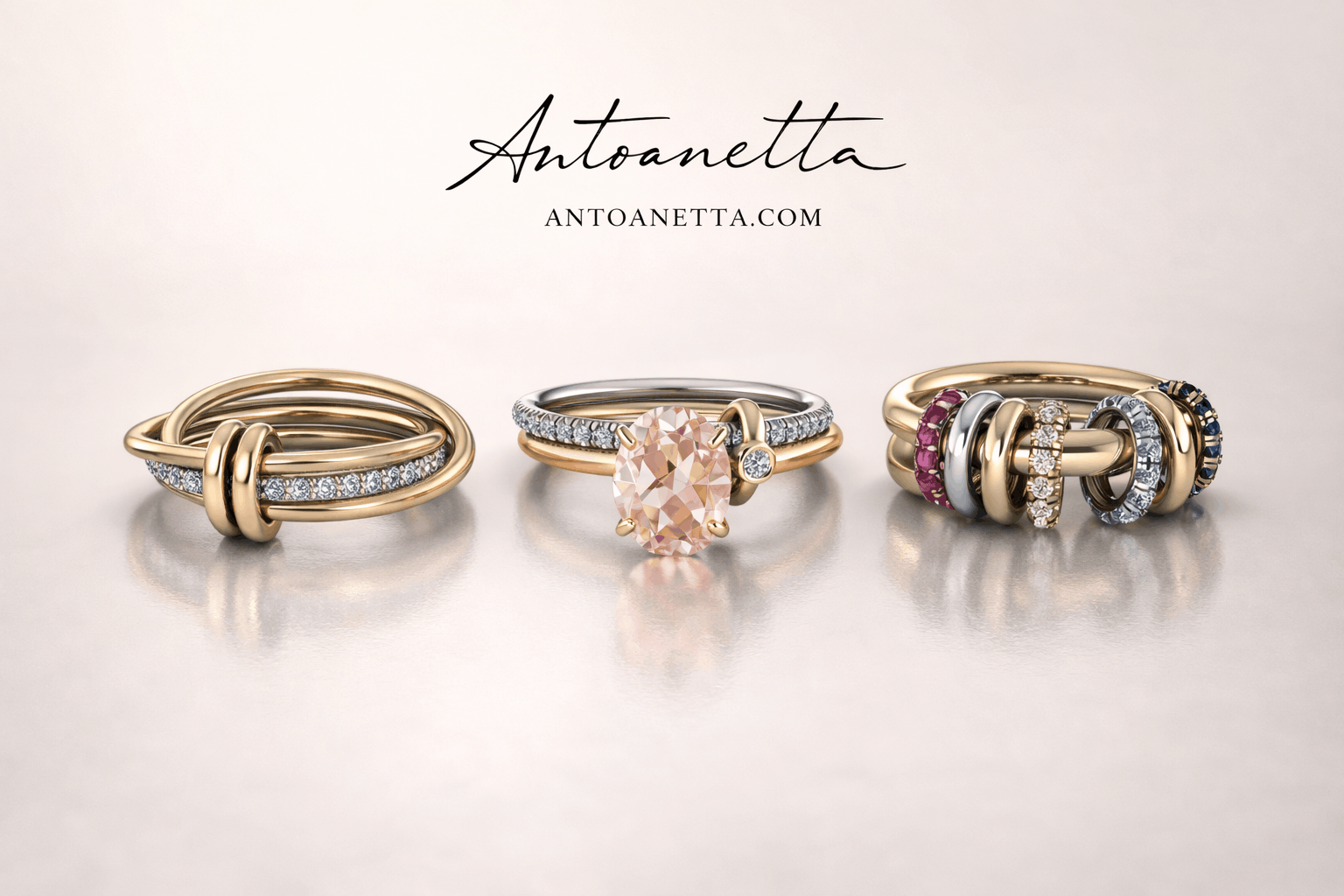
How Much Should You Spend on a Gold Ring?
There is no universal rule for how much to spend on a gold ring. The right amount depends on your budget, the ring's purpose, and how long you expect to wear it. A gold ring can cost anywhere from $150 for a simple thin band to several thousand dollars for a complex handcrafted design with gemstones. Understanding what drives the price helps you allocate your budget toward the qualities that matter most to you.
What Factors Determine the Price of a Gold Ring?
Gold weight is the most obvious factor. Gold is priced per gram, and the karat determines how much of that weight is pure gold versus alloy. A heavier ring in a higher karat costs more in raw materials alone. A wide 14k gold band weighing 8 grams contains significantly more gold than a thin band weighing 3 grams, and the price reflects that difference directly.
Gemstones add cost based on their type, quality, size, and setting method. A ring with a 0.50ct diamond in a pave setting costs more to produce than a plain gold band of the same weight - both because of the stone's value and the labor required to set it. Labor and craftsmanship are the third major factor. A handmade ring that takes a jeweler 15 hours to fabricate commands a higher price than a machine-cast ring produced in minutes, regardless of the materials involved.
What Do You Get at Different Price Points?
Under $300 typically buys a simple thin band in 10k or 14k gold with no gemstones. The design will be straightforward - a plain polished or textured band - and may be machine produced. At $300 to $800, you enter the range of wider bands, simple eternity rings, and designs with modest gemstone accents. Some handmade pieces fall into this range, particularly from independent jewelers.
Between $800 and $2,000, the options expand significantly. This range includes substantial handcrafted bands, rings with quality gemstones, mixed-metal designs, and more complex construction. At $2,000 and above, you are looking at artisan pieces with significant gold weight, premium gemstones, intricate design work, and the kind of engineering that goes into kinetic or multi-component rings. The gap between mass-produced and handmade becomes most apparent in this tier.
How Should You Think About Cost Per Wear?
A useful way to evaluate jewelry spending is cost per wear. A $2,000 ring worn every day for ten years costs about $0.55 per wear. A $200 ring worn twice a month for two years before it goes into a drawer costs about $4.17 per wear. The more expensive ring is actually the better value by this measure because it delivers more use and maintains its quality over a longer period.
This framework argues in favor of spending more on rings you plan to wear daily and less on pieces meant for occasional use. Your everyday ring should be the one where you invest in quality materials, solid construction, and a design you will not tire of. Trend pieces and seasonal jewelry can be budget purchases because their lifespan in your rotation is naturally shorter.
When Is It Worth Spending More?
Spend more when the ring has emotional significance - an anniversary, a milestone, a ring that represents something you want to carry with you. Spend more when you plan to wear it every day, because daily wear demands materials and construction that hold up. Spend more when the design is original and the craftsmanship is visible, because these are the qualities that make a ring feel special rather than generic.
Spend less when the ring is experimental, seasonal, or a style you are trying for the first time. There is nothing wrong with an affordable gold band as a starting point. If you discover you love wearing gold rings, you can always upgrade to a piece with more substance later. Explore 14k gold rings across different price ranges to see what each level of investment delivers in design and craftsmanship.
Invest in a ring that matches the moment - handcrafted in solid 14k gold.
View Gold Ring Collection